Wrist pain and dysfunction caused by arthritis, trauma, or instability can significantly impair hand function and quality of life. When conservative treatments fail to provide relief, surgical options become necessary. Among these, limited wrist fusion surgeries such as Scaphocapitate (SC) fusion and Radioscapholunate (RSL) fusion offer effective solutions to restore stability, reduce pain, and preserve some wrist motion. This article explores the indications, surgical techniques, benefits, and outcomes of these specialized wrist fusion procedures.
The wrist is a complex joint composed of eight small carpal bones arranged in two rows, articulating with the radius and ulna of the forearm. This intricate structure allows a wide range of motion including flexion, extension, radial and ulnar deviation, and circumduction. The stability and smooth function of the wrist depend on the integrity of the bones, ligaments, and cartilage.
Common conditions that may necessitate limited wrist fusion include:
When these conditions cause pain and functional limitation, and when motion-preserving surgeries are not feasible, limited wrist fusion can be an excellent option.
Limited wrist fusion refers to the surgical fusion of selected carpal bones rather than the entire wrist joint. This approach aims to eliminate painful motion at the diseased joints while preserving as much wrist mobility as possible. Unlike total wrist fusion, which results in complete loss of wrist motion, limited fusion maintains partial wrist function, allowing patients to perform daily activities with less discomfort.
Two common types of limited wrist fusion are:
Each targets specific joints and pathologies and has distinct surgical techniques and outcomes.
SC fusion is primarily indicated for patients with arthritis or instability involving the scaphoid and capitate bones, often seen in early stages of SLAC or SNAC wrist. It is also used in cases of Kienböck’s disease or post-traumatic arthritis localized to these bones.
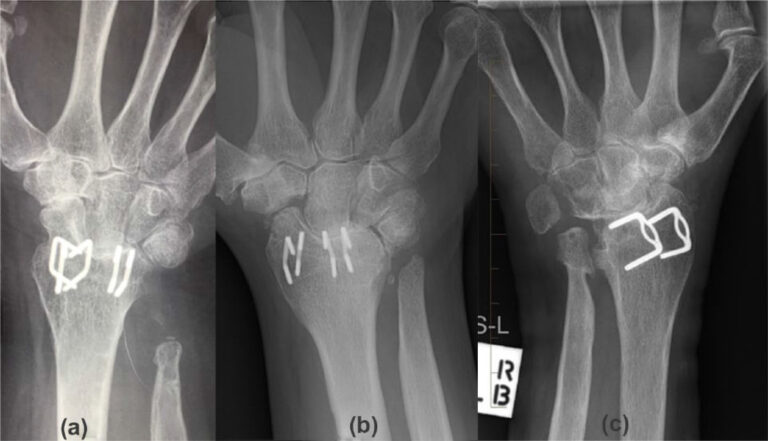
The procedure involves fusing the scaphoid and capitate bones together to stabilize the wrist and prevent abnormal motion that causes pain. The surgeon typically approaches the wrist dorsally (from the back of the hand), exposes the scaphoid and capitate, removes the cartilage surfaces between them, and prepares the bone surfaces for fusion.
Bone graft material, often harvested from the patient’s distal radius or iliac crest, is placed between the bones to promote healing. Fixation is achieved using screws or small plates to hold the bones rigidly until fusion occurs.
Studies have shown that SC fusion provides good pain relief and functional improvement in patients with localized wrist arthritis. Most patients regain approximately 50-60% of their normal wrist motion and report high satisfaction rates. Fusion typically occurs within 8-12 weeks postoperatively.
RSL fusion is indicated for more extensive arthritis involving the radioscaphoid and radiolunate joints, commonly seen in advanced SLAC or SNAC wrist stages. It is also used in cases of chronic wrist instability where these joints are compromised.
RSL fusion involves fusing the radius to the scaphoid and lunate bones, effectively stabilizing the proximal carpal row. The surgeon exposes the wrist joint, removes the cartilage from the radius, scaphoid, and lunate, and prepares the surfaces for fusion.
Bone grafts are placed between these bones, and fixation is achieved using screws or plates to maintain stability during healing. This fusion restricts motion primarily at the radiocarpal joint but preserves some midcarpal joint motion.
RSL fusion generally results in good pain relief and improved wrist stability. Patients typically retain about 30-50% of their wrist motion postoperatively. Grip strength improves, and many patients return to daily activities and work with minimal limitations. Fusion success rates are high, with most patients achieving solid fusion within 3 months.
Postoperative rehabilitation is crucial for optimal outcomes after limited wrist fusion surgeries. The wrist is immobilized in a cast or splint for 6-8 weeks to allow bone healing. Gradual mobilization and physical therapy follow to restore strength and function.
Patients are advised to avoid heavy lifting and high-impact activities for several months. Most can return to light activities within 3 months and resume full activities by 6 months, depending on individual healing and surgeon recommendations.
As with any surgery, limited wrist fusion carries risks, including:
However, these complications are relatively uncommon with proper surgical technique and postoperative care.
Limited wrist fusion surgeries such as Scaphocapitate (SC) fusion and Radioscapholunate (RSL) fusion offer effective, motion-preserving solutions for patients suffering from wrist arthritis and instability. By selectively fusing affected joints, these procedures provide significant pain relief while maintaining functional wrist motion, improving quality of life.
If you are experiencing chronic wrist pain and dysfunction that has not responded to conservative treatments, consult a hand specialist to discuss whether limited wrist fusion surgery may be appropriate for you. Advances in surgical techniques and rehabilitation continue to enhance outcomes, helping patients regain hand function and return to their daily activities with less pain.
Chat With Me