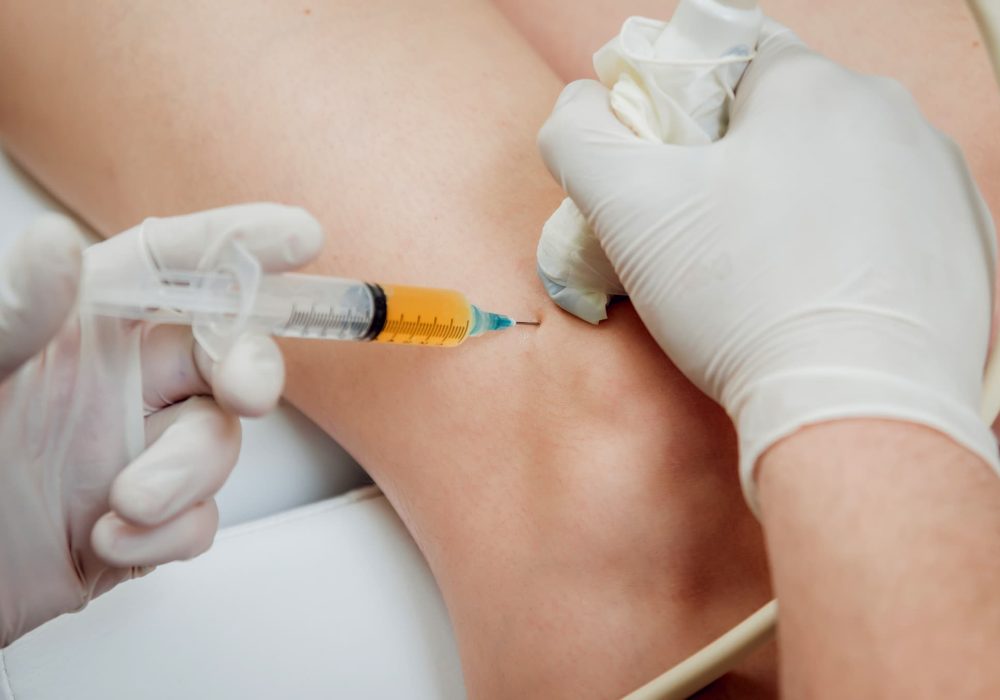
Ultrasound guided injections are medical procedures in which medications are delivered directly into specific tissues—such as joints, tendons, bursae, or soft tissue structures—using real-time ultrasound imaging for precise guidance. The technique has become increasingly popular in orthopaedics, sports medicine, pain management, and rheumatology because it improves accuracy, safety, and effectiveness compared to traditional “blind” injections performed without imaging.
By using ultrasound, clinicians can visualize the needle path and target structure in real time, ensuring that the medication is deposited exactly where it is needed. This reduces the risk of injury to surrounding nerves or blood vessels, minimizes patient discomfort, and enhances treatment outcomes.
Traditional injections rely on surface landmarks and palpation to estimate the needle’s position. While effective in some cases, this approach can be inaccurate, especially for small joints, deep structures, or complex anatomy. Ultrasound guidance addresses these challenges by providing:
Real-time visualization of tendons, ligaments, joints, and adjacent soft tissues.
Improved accuracy, ensuring the needle tip reaches the intended target.
Reduced complications, as sensitive structures like blood vessels and nerves can be avoided.
Patient confidence, since they can often see the procedure on the ultrasound screen.
These injections are used in a wide range of musculoskeletal and medical conditions, including:
Joint injections
Shoulder, elbow, wrist, hip, knee, and ankle joints.
Helpful for arthritis, bursitis, or synovitis.
Tendon sheath or peritendinous injections
For conditions such as trigger finger, De Quervain’s tenosynovitis, or Achilles tendinopathy.
Bursal injections
Targeting inflamed bursae, e.g., subacromial bursitis in the shoulder or trochanteric bursitis in the hip.
Nerve-related injections
For peripheral nerve entrapments or neuropathic pain conditions.
Soft tissue or cyst aspiration
For draining ganglion cysts or localized fluid collections under guidance.
The choice of medication depends on the condition being treated. Commonly used agents include:
Corticosteroids: To reduce inflammation and pain.
Local anesthetics: For immediate pain relief and diagnostic purposes.
Hyaluronic acid: Often used in osteoarthritis to improve joint lubrication.
Platelet-rich plasma (PRP) or biologic agents: For regenerative treatments aimed at tendon or joint healing.
Ultrasound guided injections are typically performed in an outpatient or clinic setting.
Preparation: The area is cleaned, and the ultrasound probe is covered with sterile gel and a sheath.
Identification of target: The clinician uses ultrasound to locate the joint, tendon, or soft tissue requiring treatment.
Needle insertion: Under continuous ultrasound visualization, the needle is advanced toward the target. Patients can sometimes watch the needle move in real time on the screen.
Injection or aspiration: Once the needle tip is confirmed in the correct position, the medication is injected or fluid is aspirated.
Post-procedure: A small dressing is applied, and patients are typically observed briefly before leaving.
The entire procedure is generally quick, minimally painful, and does not usually require sedation.
Greater accuracy: Ensures delivery of medication exactly to the affected site.
Improved outcomes: Studies show higher effectiveness compared to blind injections in many conditions.
Reduced side effects: By avoiding unnecessary spread of medication to surrounding tissues.
Early return to activity: Patients often experience faster relief, helping them resume daily tasks or rehabilitation.
Diagnostic value: In addition to guiding treatment, ultrasound can also confirm the diagnosis by identifying inflammation, fluid collections, or tendon pathology.
While generally safe, ultrasound guided injections carry some risks, though these are uncommon:
Pain or discomfort at the injection site.
Bleeding or bruising.
Infection, though rare with proper sterile technique.
Allergic reaction to medications used.
Temporary increase in pain after injection (post-injection flare).
In rare cases, incomplete relief or recurrence of symptoms.
Following an ultrasound guided injection, patients are usually advised to:
Rest the treated area for a short period (often 24–48 hours).
Apply ice packs if mild swelling or soreness occurs.
Avoid heavy physical activity for a few days, depending on the site and type of injection.
Resume physiotherapy or rehabilitation programs as directed by the treating physician.
Most people are able to return to normal daily activities quickly, often with improved comfort and mobility.
The effectiveness of ultrasound guided injections varies with the underlying condition, medication used, and the patient’s overall health. Many patients experience significant pain relief, reduced inflammation, and improved function. For degenerative or chronic conditions such as arthritis or tendon disease, injections can provide temporary but valuable symptom control, often in combination with physiotherapy and lifestyle modifications.
For biologic treatments such as PRP, ultrasound guidance ensures precise delivery to the intended site, which may enhance regenerative outcomes.
Ultrasound guided injections represent a significant advancement in musculoskeletal care. By combining modern imaging with targeted treatment, these procedures improve accuracy, safety, and effectiveness. They are particularly valuable for patients with joint disorders, tendon injuries, bursitis, or nerve entrapments, where precise delivery of medication is essential. Though not a cure for underlying diseases, ultrasound guided injections play a critical role in pain management, functional restoration, and as an adjunct to rehabilitation programs. With their minimally invasive nature and high success rate, they have become a trusted tool for clinicians and patients seeking targeted relief from musculoskeletal problems.
Chat With Me