
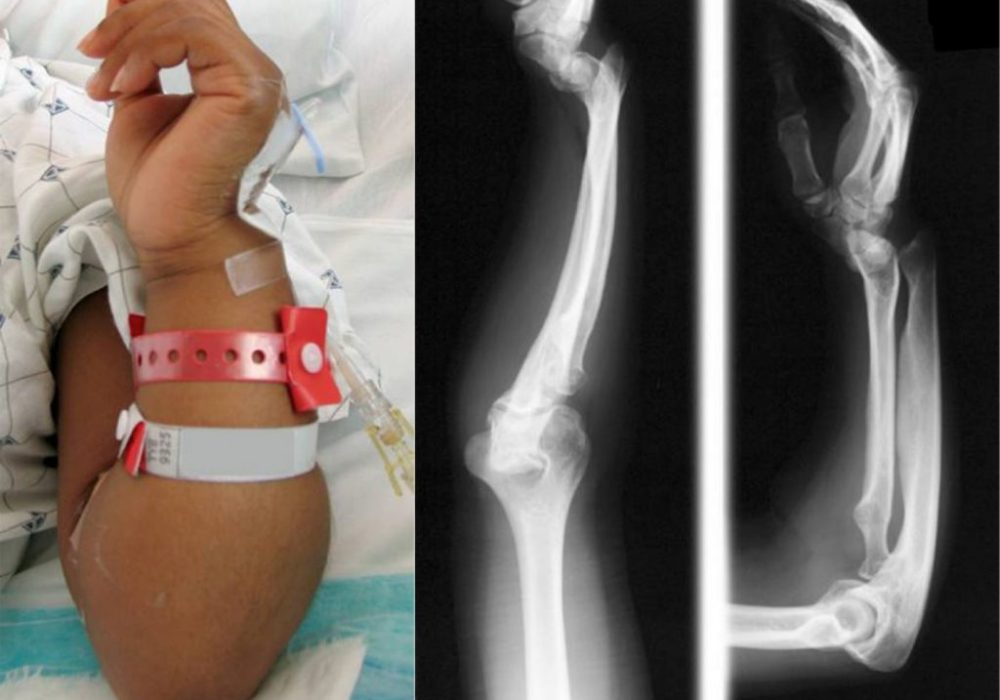
Madelung’s deformity is a rare congenital condition characterized by abnormal growth of the distal radius, leading to a progressive deformity of the wrist. This deformity results in a characteristic wrist appearance, pain, limited range of motion, and functional impairment. It primarily affects adolescents and young adults, often becoming more noticeable during the growth spurt in puberty. Early diagnosis and appropriate management are crucial to prevent long-term disability and improve wrist function.
Madelung’s deformity is a developmental disorder of the wrist where the growth plate (physis) of the distal radius is partially or completely arrested on the volar (palm) and ulnar (little finger) side. This asymmetric growth disturbance causes the radius to curve abnormally, while the ulna (the other forearm bone) continues to grow normally. As a result, the ulna becomes relatively longer and displaces dorsally (towards the back of the hand), causing the wrist to tilt and the hand to deviate towards the ulna side.
The deformity is often bilateral but can be unilateral. It is more common in females and may be associated with genetic conditions such as Leri-Weill dyschondrosteosis, which involves mutations in the SHOX gene.
The exact cause of Madelung’s deformity is not fully understood, but it is believed to be related to abnormal development or injury to the growth plate of the distal radius. The key pathological feature is the presence of a Vickers ligament, an abnormal thickened ligament tethering the lunate bone to the radius, which restricts normal growth and contributes to the deformity.
Genetic factors play a significant role, especially in familial cases. The SHOX gene mutation leads to defective bone growth and is implicated in many patients with Madelung’s deformity. Trauma or infection affecting the growth plate can also cause similar deformities but are classified separately as post-traumatic or acquired deformities.
Patients with Madelung’s deformity typically present during adolescence with:
In some cases, the deformity is mild and asymptomatic, discovered incidentally during evaluation for other issues.
Diagnosis of Madelung’s deformity is primarily clinical, supported by radiographic imaging.
X-rays of the wrist are essential and typically show:
Additional imaging such as MRI can help visualize soft tissue abnormalities like the Vickers ligament and assess cartilage and growth plate status.
The management of Madelung’s deformity depends on the severity of symptoms, degree of deformity, and patient age. Treatment goals include pain relief, correction of deformity, restoration of wrist function, and prevention of progression.
In mild cases or in patients with minimal symptoms, conservative treatment may be sufficient:
However, non-surgical treatment does not correct the deformity and is mainly symptomatic.
Surgery is indicated in patients with significant pain, functional impairment, or progressive deformity. Various surgical techniques exist, tailored to the individual patient’s anatomy and deformity characteristics.
This procedure involves excision or release of the abnormal Vickers ligament to remove the tethering effect on the distal radius growth plate. It is most effective in younger patients with open growth plates and mild deformity. Early intervention can prevent progression.
Osteotomy involves cutting and realigning the radius and sometimes the ulna to restore normal wrist alignment. Types of osteotomies include:
Osteotomy can improve wrist mechanics, reduce pain, and enhance function. It is often combined with ulnar shortening if the ulna is relatively long.
Since the ulna is often relatively longer and subluxated, shortening the ulna can help balance the wrist joint and reduce pain. This procedure is frequently performed alongside radius osteotomy.
In severe cases with arthritis or irreparable deformity, wrist fusion (arthrodesis) may be considered to provide pain relief and stability at the expense of wrist motion.
After surgery, immobilization with a cast or splint is necessary to allow bone healing. The duration depends on the procedure performed but typically ranges from 6 to 12 weeks.
Physical therapy plays a vital role in recovery, focusing on:
Madelung’s deformity is a complex wrist condition that can significantly impact quality of life if left untreated. Understanding its pathophysiology, clinical features, and treatment options is essential for effective management. Advances in surgical techniques have improved the ability to correct deformities and restore wrist function. If you or a loved one is experiencing wrist pain or deformity, early consultation with an orthopedic specialist is recommended to explore the best treatment approach.
Chat With Me