The elbow joint plays a crucial role in the function of the upper limb, allowing for a wide range of motion including flexion, extension, pronation, and supination. Any deformity affecting the elbow can significantly impair arm function and aesthetics. Among the common deformities of the elbow are Cubitus Varus and Cubitus Valgus, which refer to abnormal angulations of the forearm relative to the upper arm when the elbow is extended.
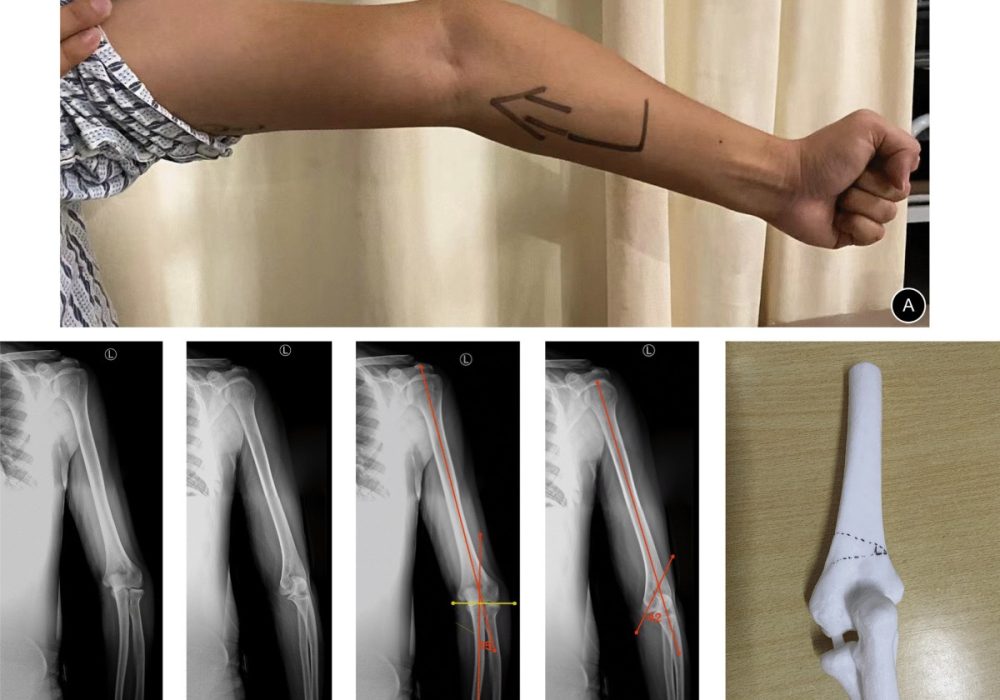
Cubitus varus, often called the “gunstock deformity,” is characterized by an inward angulation of the forearm relative to the humerus when the arm is extended and supinated. In this condition, the forearm deviates towards the midline of the body, resulting in a varus (medial) angulation at the elbow.
This deformity is most commonly a sequela of malunited supracondylar fractures of the distal humerus in children. It can also result from growth disturbances or improper healing after trauma.
Cubitus valgus is the opposite deformity, where the forearm deviates away from the midline, creating a valgus (lateral) angulation at the elbow. This condition is less common than cubitus varus and may arise due to lateral condyle fractures, growth plate injuries, or congenital causes.
Cubitus valgus is clinically significant because it can be associated with tardy ulnar nerve palsy due to stretching of the ulnar nerve over the medial epicondyle.
The management of cubitus varus and valgus deformities depends on the severity of the deformity, symptoms, patient age, and functional impairment.
Surgery is indicated in cases with significant deformity, functional impairment, or neurological symptoms.
Osteotomy is the most common surgical procedure for correcting cubitus varus or valgus. It involves cutting and realigning the distal humerus to correct the angulation.
Lateral Closing Wedge Osteotomy
Medial Opening Wedge Osteotomy
Dome Osteotomy
Step-Cut Osteotomy
Deformities of the elbow such as cubitus varus and cubitus valgus can significantly affect arm function and appearance. While mild cases may be managed conservatively, significant deformities often require surgical correction through osteotomy and realignment. Advances in surgical techniques and fixation methods have improved outcomes, allowing patients to regain normal elbow function and appearance. Early diagnosis, appropriate treatment, and dedicated rehabilitation are key to successful deformity correction.
Chat With Me